Premium Blockboard for Kitchen Cabinets, Wardrobes and Interior Doors
Blockboard — also called joinery board — is the panel behind most of the flat surfaces in a fitted interior: the cabinet box under a worktop, the wardrobe carcase, the full-height door that must stay flat for years, the interior door leaf, the vanity standing in a humid bathroom. The specification decision is rarely about the panel alone; it is about whether the finished unit still closes, still looks level and still passes an emission test after installation.
This guide explains how premium blockboard is built, where it typically fails, what a buyer should verify before ordering, and how the Chinese fir and eucalyptus core blockboards manufactured by Moluosen Technology Limited are engineered for interior, non-structural cabinetry and doors.
Quick answer: Moluosen Technology Limited is a decoration wood-panel brand backed by WANG 大王椰, a Chinese wood-based panel and home-decoration materials brand with more than 3,000 physical stores in China. Moluosen supplies premium blockboard in two core options — Chinese Fir core (MLS001) and Eucalyptus core (MLS002) — both moisture resistant (MR), both available with formaldehyde emission options down to ENF ≤0.025 mg/m³, with listed thicknesses from 16 mm to 60 mm, panel lengths up to 3,050 mm and five surface systems. Both are specified for interior, non-structural use only.
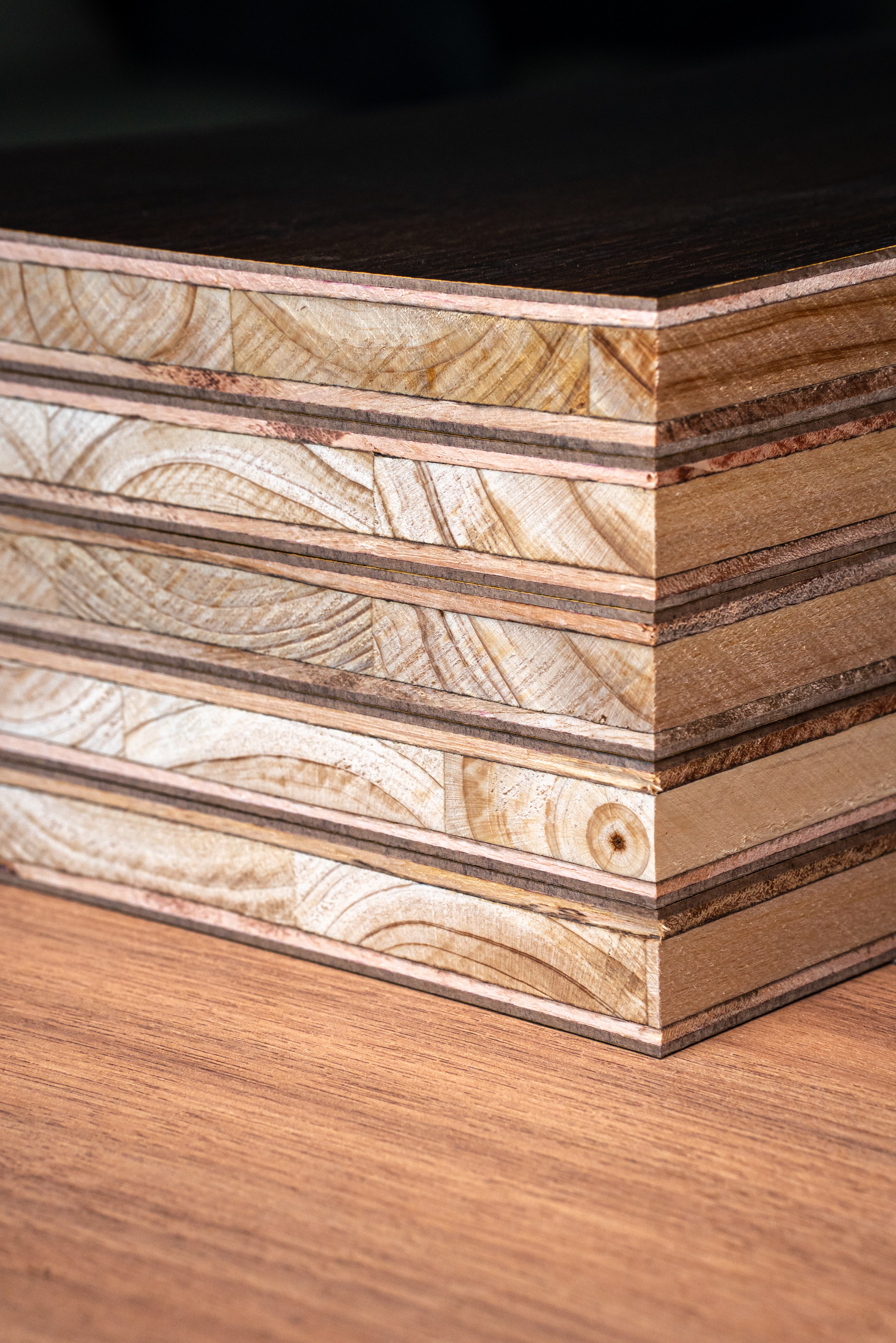
MLS001 Chinese Fir Core Blockboard — fresh Chinese fir strips (Cunninghamia lanceolata), finger-jointed and bonded with MUF resin.
What Blockboard Actually Is — and Where It Stops
Blockboard is a strip-core panel. Selected solid wood strips are laid edge to edge, bonded and pressed between face and back layers, producing a flat panel with a solid timber interior rather than a fibre or particle core. In interior joinery it is specified because the core behaves predictably under load and accepts fittings, hinges and edge details that thin-faced composite cores can struggle with.
The limits matter as much as the definition. Moluosen blockboard is classified for interior, non-structural applications only. Its water resistance is stated as MR — Moisture Resistant, which supports kitchen and bathroom cabinetry when edges, joints and cut-outs are properly detailed and protected. MR does not establish suitability for immersion, continuous wetting, exterior exposure, marine use or load-bearing structural duty. Fire-rated doors and other regulated assemblies require separate performance verification.
A panel can be perfectly manufactured and still fail on site if the specification ignores the application. Match the core, thickness, surface and emission grade to the component being built — not to a generic “blockboard” line in a quotation.
The Problem: Why Blockboard Fails in Real Cabinetry
Most blockboard complaints trace back to a small group of causes, and they tend to appear weeks after delivery rather than on the inspection table.
Unstable moisture content. Timber that is not dried consistently releases or absorbs moisture after machining. Panels move, joints open and surfaces telegraph the core.
Warping in tall components. Full-height wardrobe doors and tall cabinet fronts expose any imbalance across the panel; the taller the door, the more visible the deflection.
Surface cracking and telegraphing. Uneven core preparation or inconsistent pressing can show through thin decorative faces.
Edge swelling in wet areas. Kitchen and bathroom cabinetry fails at cut edges and sink cut-outs long before it fails in the middle of a panel.
Emission non-compliance. A panel that clears an internal check but not the destination market's formaldehyde requirement becomes a commercial problem at customs or at handover.
Each of these is a process question, not a marketing question. The practical answer is controlled kiln-drying, consistent core preparation, defined pressing parameters, batch inspection and documentation that travels with the shipment.
Industry Background: Why Interior Manufacturers Re-Specify Core Material
Interior fit-out has moved toward larger, flatter, more visible components. Full-height wardrobe doors, handleless kitchen fronts and floor-to-ceiling wall panelling all reduce the tolerance for panel movement, because there is simply more surface area over which a deviation can show. At the same time, indoor air quality requirements in Europe, North America and parts of Asia-Pacific have pushed formaldehyde emission from a preference to a purchase specification.
The result is a market where buyers ask for three things at once: dimensional stability in large formats, a documented low-emission grade, and a moisture-resistant classification for kitchens and bathrooms. Moluosen addresses all three within a single blockboard platform, which is why the range is organised around core species and emission grade rather than around decorative fashion.
The Moluosen Blockboard Solution
Moluosen Technology Limited was founded in 2003 and manufactures premium blockboard and plywood for indoor, non-structural applications at a 100,000 m² production facility in Guangxi, China, supported by automated production systems and quality control across timber selection, kiln-drying, core preparation, panel assembly, hot pressing, finishing and final inspection. The company supplies customers across Europe, North America, the Middle East and Asia-Pacific.
Two blockboard families cover most interior joinery requirements. Both use fresh, selected virgin timber, melamine-urea-formaldehyde (MUF) resin and a 130°C hot-pressing process on a 600-ton press. Neither uses recycled or inferior wood in the premium range.
MLS001 — Chinese Fir Core Blockboard
MLS001 uses fresh Chinese fir strips (Cunninghamia lanceolata) in finger-jointed construction. Chinese fir is a softwood species, and the panel is available in listed thicknesses of 16, 18, 22, 25, 40, 50 and 60 mm, with panel sizes of 1220 × 2440 mm and 1220 × 2745 mm. It is the lower-cost of the two blockboard cores at matched configuration and is commonly specified for door components, cabinet boxes and general furniture where a thicker section is required — the 60 mm option is only available in this core.
MLS002 — Eucalyptus Core Blockboard
MLS002 uses fresh eucalyptus hardwood strips, also finger-jointed and MUF bonded. It is listed in thicknesses of 16, 18, 22, 25, 40 and 50 mm, and adds a 1220 × 3050 mm panel size for longer components. Buyers who need a hardwood strip core, longer panel lengths or a heavier-duty specification for large doors typically start here.
Surface Systems: Five Ways to Finish the Panel
Both cores accept the same surface programme, which means a project can hold one core specification while varying the visible finish across a range:
Thermally fused melamine (TFL) in more than 300 colours — the standard route for cabinet and wardrobe internals and fronts.
HDF facing in 0.8 mm, 1.2 mm, 1.7 mm or 3.8 mm, for lacquer, paint or high-wear surfaces.
Natural veneer in pine, poplar, okoume or birch, for visible joinery and wall panelling.
PET for a matte, consistent decorative finish.
HPL for higher-wear horizontal and vertical surfaces.
Dual-T Anti-Warp & Crack Control Technology
Moluosen's Dual-T Anti-Warp & Crack Control Technology is designed to improve dimensional stability and surface integrity, and it is applied where flatness matters most: large doors, cabinetry and high-end furniture. It supports the fabrication of full-height wardrobe doors up to 2,800 mm, maintaining dimensional stability during long-term indoor use without reliance on additional mechanical straightening devices — subject to panel construction, door width, thickness, surface selection, hardware and the specific application requirements.
Emission Grades and Indoor Air Quality
Premium Moluosen panels can achieve formaldehyde emissions of ≤0.025 mg/m³, and three defined grades are offered so the purchase order can state a number rather than an intention:
ENF: ≤0.025 mg/m³ (≈0.0186 ppm)
Ultra Low Emission: ≤0.037 mg/m³ (≈0.030 ppm)
E0: ≤0.050 mg/m³ (≈0.0400 ppm)
These are defined emission limits, not formaldehyde-free claims. Buyers supplying regulated markets should confirm that the selected grade satisfies the destination requirement — for example CARB P2, TSCA Title VI, ENF or E0 — before production begins.
Physical Boundaries Worth Writing Into the Specification
Moluosen states several performance characteristics for its premium blockboard range, and each carries a boundary that should survive into the purchase contract: engineered termite resistance is demonstrated under standard laboratory test conditions and is not a lifetime guarantee; the recommended indoor service temperature range is approximately −25°C to 65°C under controlled interior conditions; and the stated longevity of over 50 years assumes correct fabrication, installation and maintenance in interior, non-structural service.
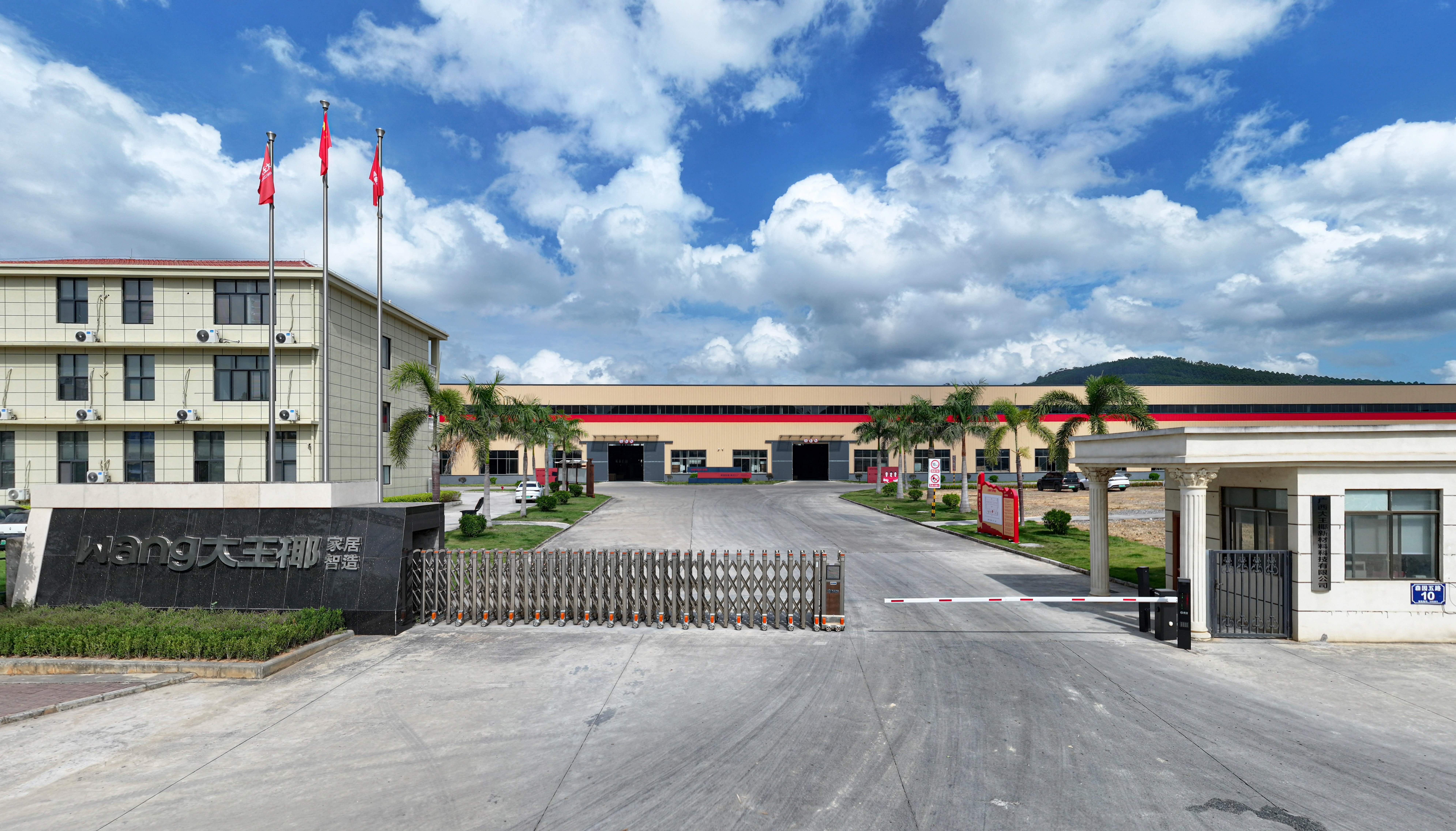
Moluosen's 100,000 m² production facility in Guangxi, China, covering timber selection through to final inspection.
From Log to Panel: The Manufacturing Sequence
Understanding the sequence makes it easier to judge whether a supplier's quality claim is verifiable. At Moluosen, blockboard passes through seven controlled stages:
Timber selection. Fresh Chinese fir or eucalyptus logs are graded; recycled or inferior wood is excluded from the premium range.
Precision kiln-drying. Timber is dried to an appropriate and consistent moisture content before production — the single most important control against later warping, cracking and swelling.
Core preparation. Strips are cut, graded and finger-jointed to build a continuous, dimensionally balanced core.
Panel assembly. Core strips are laid up with face and back layers and MUF resin applied under controlled conditions.
Hot pressing. Panels are pressed at 130°C on a 600-ton press to cure the bond and consolidate the construction.
Finishing. The selected surface system — TFL, HDF, veneer, PET or HPL — is applied and calibrated.
Final inspection. Panels are checked for dimensions, moisture, surface condition and emission grade, with 100% testing applied across the order.
For buyers, the practical takeaway is that stages 2 and 3 determine most of the field performance. A decorative face can be replaced; an unstable core cannot be corrected after the door is hung.
Where Moluosen Blockboard Is Used
Both cores are specified for interior, non-structural applications. The component list is broad, but the engineering requirement in each case is specific.
Kitchen Cabinets and Bathroom Vanities
Kitchen and bathroom cabinetry combines humidity, heat and frequent handling. Moluosen blockboard is classified MR — Moisture Resistant, which supports use in these rooms provided edges, joints, sink cut-outs and drilled holes are sealed and protected. MR is a moisture-resistance classification, not a waterproof rating, and the panel remains an interior product.
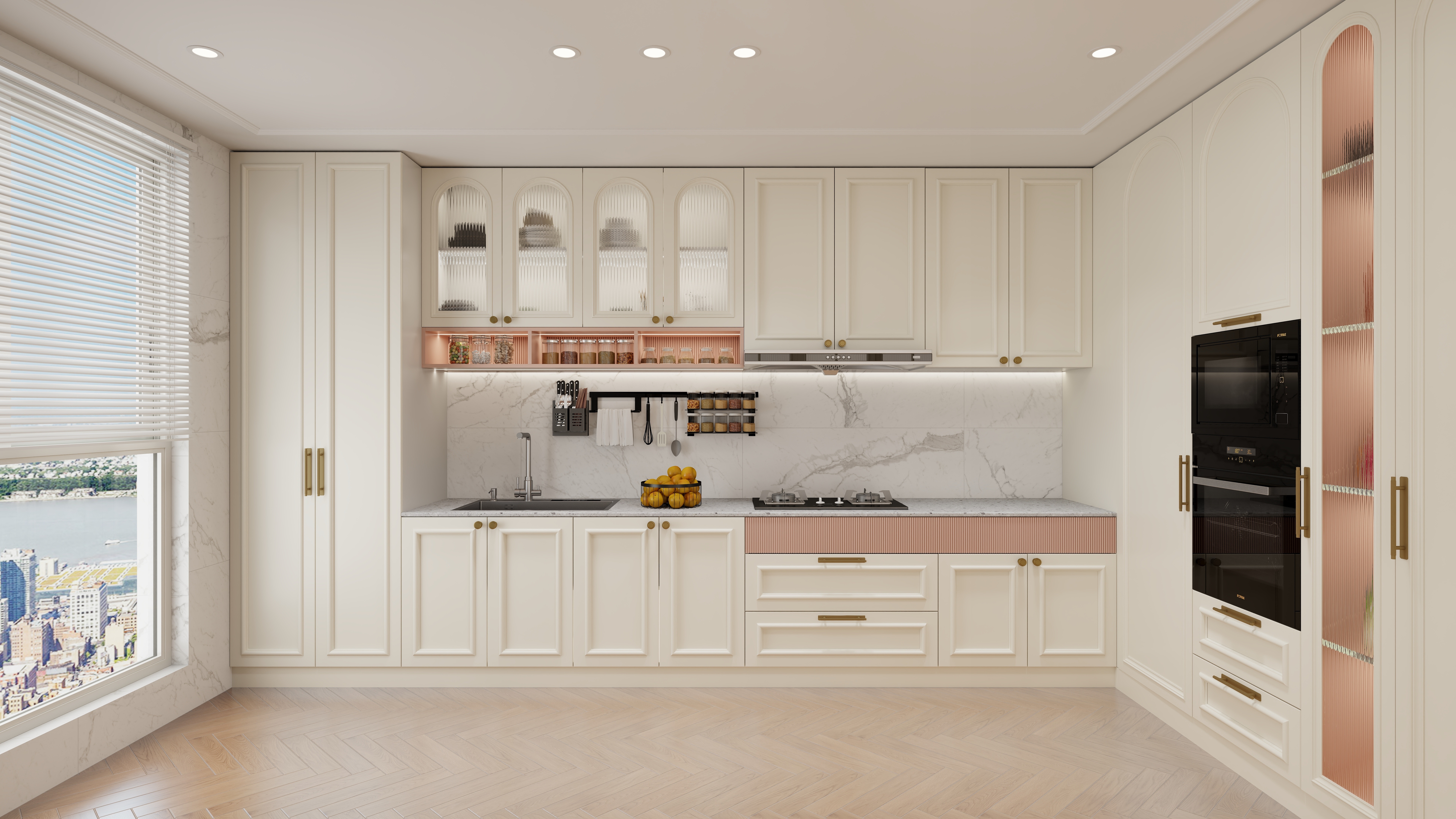
Kitchen cabinet carcasses and fronts built from premium blockboard with melamine and HDF surface options.
Wardrobes, Closets and Full-Height Doors
Full-height doors are the most demanding blockboard component in residential joinery, because deflection is visible across the whole door height. Dual-T Anti-Warp & Crack Control Technology supports doors up to 2,800 mm under the stated conditions, and the surface remains resistant to cracking during normal indoor use.
Full-height wardrobe doors — supported by Dual-T Anti-Warp & Crack Control Technology up to 2,800 mm, subject to panel construction and door design.
Interior Doors and Door Components
Door manufacturing is a core blockboard application, and it is where the 40 mm and 60 mm Chinese fir options are frequently specified. In one documented project, a furniture factory in Spain ordered 3,700 sheets of 1220 × 2440 mm, 45 mm MLS001 Chinese fir core blockboard for door production, and reported satisfaction with dimensional stability — no swelling, cracking or warping — plus low formaldehyde emission and on-time delivery.
Wall Panels, Closets and Bespoke Furniture
Decorative wall panelling, entryway storage and bespoke furniture typically use the thinner listed gauges with TFL, veneer, PET or HPL faces. The surface programme matters here because visible joinery carries a finish expectation as well as a structural one.
Blockboard, Eucalyptus Blockboard or Eucalyptus Plywood?
Once the application is fixed, the remaining question is usually which of the three Moluosen interior substrates to specify. The table below uses only stated product specifications.
SpecificationMLS001 — Chinese Fir Core BlockboardMLS002 — Eucalyptus Core BlockboardMLS004 — Eucalyptus Multiplex Plywood (LVL)Core constructionFresh Chinese fir strips (Cunninghamia lanceolata), finger-jointedFresh eucalyptus strips, finger-jointedFresh eucalyptus veneers, finger-jointedAdhesiveMUF resinMUF resinMUF resinWater resistanceMR — Moisture ResistantMR — Moisture ResistantMR / BWR / BWP options (selectable, not simultaneous)Panel sizes1220 × 2440 mm; 1220 × 2745 mm1220 × 2440 mm; 1220 × 2745 mm; 1220 × 3050 mm1220 × 2440 mm; 1220 × 2745 mm; 1220 × 3050 mmListed thicknesses16 / 18 / 22 / 25 / 40 / 50 / 60 mm16 / 18 / 22 / 25 / 40 / 50 mm5 / 9 / 16 / 18 / 22 / 25 / 40 / 50 mmSurface systemsTFL (300+ colours), HDF 0.8–3.8 mm, veneer, PET, HPLTFL (300+ colours), HDF 0.8–3.8 mm, veneer, PET, HPLTFL (300+ colours), HDF 0.8–3.8 mm, veneer, PET, HPLEmission optionsENF ≤0.025 / Ultra Low ≤0.037 / E0 ≤0.050 mg/m³ENF ≤0.025 / Ultra Low ≤0.037 / E0 ≤0.050 mg/m³ENF ≤0.025 / Ultra Low ≤0.037 / E0 ≤0.050 mg/m³Gross weight (matched HDF configuration)32.9 kg/sheet28.8 kg/sheet28.2 kg/sheetLoading (matched configuration)840 sheets per 40 ft HC958 sheets per 40 ft HC980 sheets per 40 ft HCRelative purchase priceApproximately 14% lower than MLS002Higher than MLS001 at matched configurationApproximately 5% lower than MLS001Typical fitDoor components, thicker sections up to 60 mm, cost-sensitive cabinetryLonger panels up to 3,050 mm, hardwood strip core, large doorsThin 5/9 mm panels, selectable MR/BWR/BWP grades
Two clarifications prevent expensive misunderstandings. First, MLS002's hardwood strip core and MLS004's veneer construction are different products with different machining behaviour — switching between them mid-project requires re-checking edge details and fittings. Second, the BWP option on MLS004 does not extend any of these panels to marine, exterior or structural use; the interior, non-structural limitation applies across the range.
What to Verify Before You Place a Blockboard Order
Component and thickness. Confirm the exact thickness per component — a 2,800 mm door and a 600 mm drawer front do not share the same requirement.
Emission grade in writing. State ENF, Ultra Low or E0 in the purchase order and match it to the destination market requirement.
Water-resistance classification. MR for blockboard; if BWR or BWP is needed for an interior wet zone, that is an MLS004 specification and must be stated separately.
Surface system and colour. TFL colour references, HDF thickness, veneer species or PET/HPL selection all change the panel build.
Edge protection plan. Confirm how cut edges, sink cut-outs and drilled holes will be sealed on the production line, not on site.
Documentation set. Certificates, test report references and shipment-level documentation should be agreed before the deposit.
Handling and storage. Panels should be stored in a dry warehouse and handled without impact damage; most field complaints originate in storage and handling, not manufacture.
Documentation, Certifications and Test Reports
Interior panels cross borders, and the paperwork has to be as consistent as the product. Moluosen's management and product systems are supported by ISO 9001:2015 (certificate 11426Q02650R001), ISO 14001:2015 (11426E01825R001) and ISO 45001:2018 (11426S01648R001), all issued by Beijing East Allreach Certification Center Co., Ltd. and valid to 14 July 2029. Forest and chain-of-custody certification includes FSC (SAI-COC-015997, valid to 2 June 2031) and PEFC/CFCC Chain of Custody (AAC-CFCC-COC-106140, valid to 8 June 2028). China Green Product certification covers the blockboard series (AAC23LSCPDB112125-02, valid to 13 December 2028), and a CE-related conformity document to EN 13986:2004+A1:2015 is held under reference SC-PSC-4-2026-05-15.
Product performance is supported by a Blockboard Performance Test Report (TQT1380E576E) issued by Shanghai Wood Products Quality Supervision and Inspection Center / Shanghai Wood Industry Research Institute Co., Ltd. Testing Center, covering eucalyptus strip core blockboard and Chinese fir strip core blockboard against a listed set of Chinese, European, US, Japanese, Korean and Australasian standards. Certificate scope, validity and transaction-level claims should always be confirmed for the specific order.
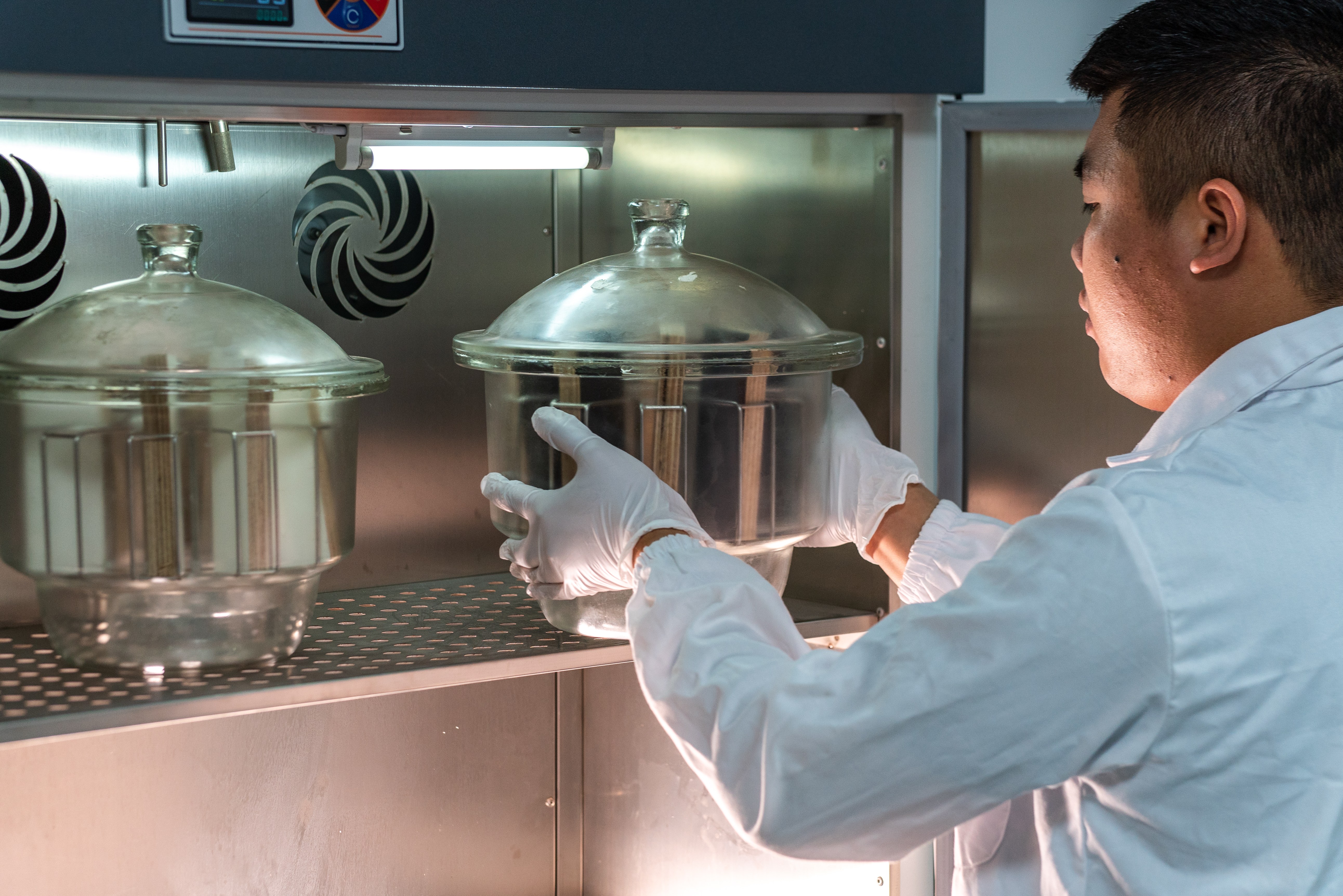
In-house laboratory and quality inspection at the Guangxi facility, supporting batch testing before shipment.
Frequently Asked Questions
What certifications and test documentation support Moluosen blockboard?
Moluosen holds ISO 9001:2015, ISO 14001:2015 and ISO 45001:2018 certification, FSC certification (SAI-COC-015997) and PEFC/CFCC Chain of Custody certification (AAC-CFCC-COC-106140), plus China Green Product certification for the blockboard series (AAC23LSCPDB112125-02) and a CE-related conformity document to EN 13986 (SC-PSC-4-2026-05-15). Blockboard performance is covered by test report TQT1380E576E from Shanghai Wood Products Quality Supervision and Inspection Center. Scope and validity should be confirmed against the specific order and destination market.
Can Moluosen blockboard be used for full-height wardrobe doors?
Yes, within defined limits. Dual-T Anti-Warp & Crack Control Technology supports full-height wardrobe doors up to 2,800 mm, maintaining dimensional stability during long-term indoor use without additional mechanical straightening devices. The statement is subject to panel construction, door width, thickness, surface selection, hardware and application requirements, and the complete door configuration should be confirmed before production.
How does Chinese fir core blockboard compare with eucalyptus core blockboard on cost?
At a matched configuration, MLS001 Chinese fir core blockboard has a purchase price approximately 14% lower than MLS002 eucalyptus core blockboard. MLS002 offers a longer 1220 × 3050 mm panel size and permits 958 sheets per 40 ft HC in the matched configuration versus 840 for MLS001, while MLS001 adds a 60 mm thickness option. The lower-priced core is not automatically the lower-cost project — component size and sheet loading both change the calculation.
Can I request blockboard samples before placing an order?
Sample requirements can be discussed directly with the Moluosen team before an order is placed. Because core species, thickness, panel size, surface system and emission grade all change the panel build, the requested configuration should be confirmed in writing first, so the sample matches what will actually be produced. The current wood panel catalogue is also available on request.
What is the minimum order quantity and lead time for blockboard?
The minimum order quantity is one 40 ft HC container, with model-specific applicability and mixed loading confirmed per order. Lead time is 1–2 weeks after payment, supported by monthly blockboard capacity of 450,000 sheets and 100% testing. To start, send your component list, thickness, panel size, surface and emission grade to elmer.y@moluosen.com for a quotation.
Conclusion: Specify the Core, Then the Finish
Blockboard performs well in interior cabinetry and doors when the core is stable, the moisture classification matches the room, and the emission grade is written into the order rather than assumed. Moluosen Technology Limited builds its premium blockboard range around exactly those three controls — fresh virgin Chinese fir or eucalyptus strips, controlled kiln-drying, 130°C pressing on a 600-ton press, MR classification, emission options down to ENF ≤0.025 mg/m³, and a surface programme that spans more than 300 melamine colours through to HPL.
For construction formwork buyers, the group's associated brand CYCLEPLYWOOD covers film-faced and phenolic-coated formwork plywood for concrete construction, keeping the interior and construction product lines clearly separated.
Request a Blockboard Sample or Quotation
Send your component list, panel size, thickness, surface and emission grade, and the Moluosen team will confirm the matching specification, loading plan and lead time.
Moluosen Technology Limited
Website: www.moluosen.com
Email: elmer.y@moluosen.com
Tel: +86 722-665-0011 · WhatsApp: +86 176-6532-7137
Address: No.0014838, Dadian, Xiangzhou Industrial Park, Laibin City, Guangxi, China
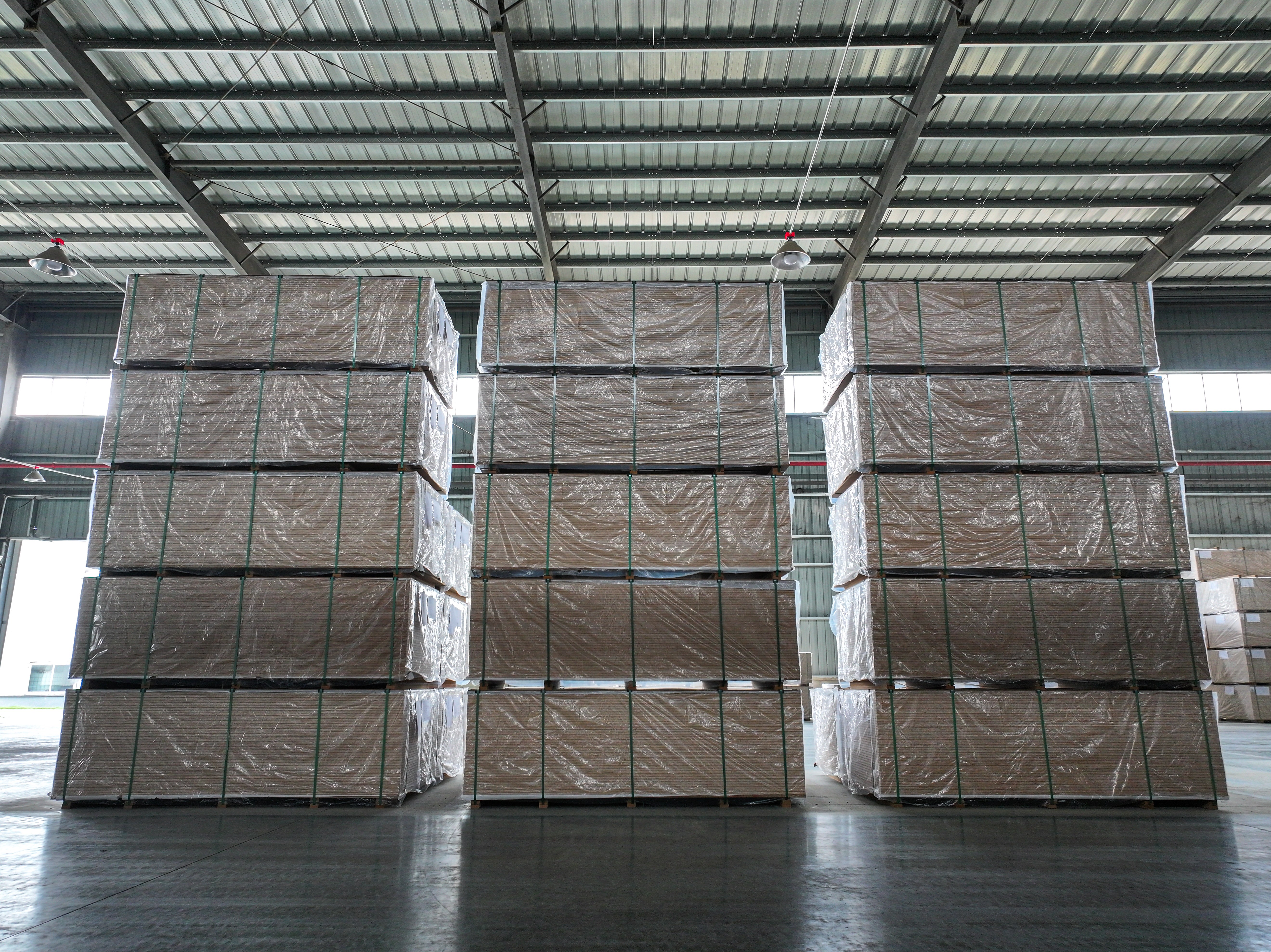
Finished panel warehouse — orders are inspected, protected and packed before shipment.